
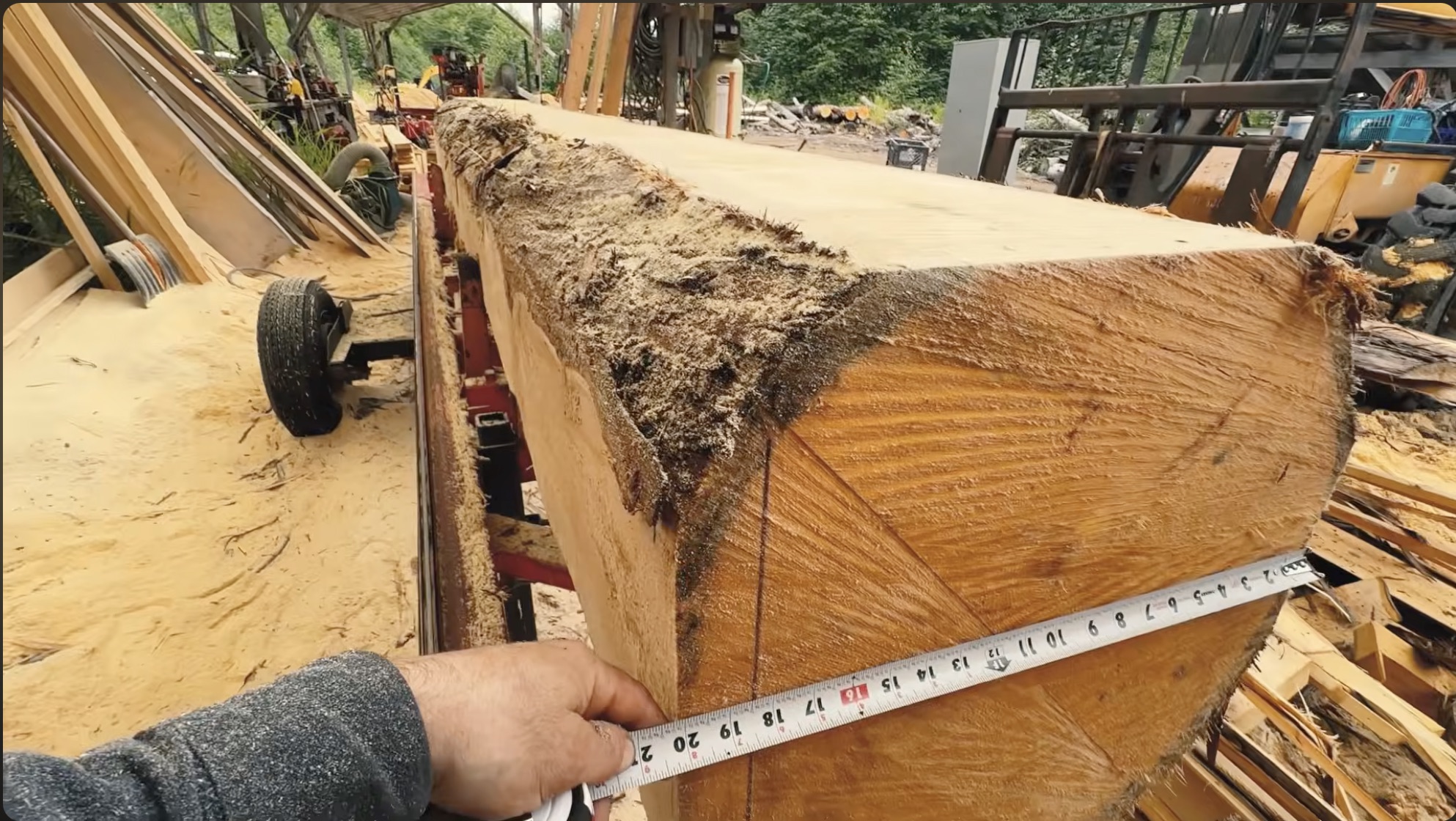
It’s quite an honor to put a log like this on the sawmill. Alaska yellow cedar is a legendary wood in this part of the world, valued for its beauty, its usefulness, and its remarkable resistance to rot. In this video, we’re at the Tenakee Logging Company sawmill, turning an old growth yellow cedar log into full 2×6 lumber.
Yellow cedar grows here in the rainforests of the Tongass, where moisture is a constant companion and most things return to the forest floor fairly quickly. Yellow cedar takes its time. Its heartwood is so resistant to decay that dead trees can remain standing for decades, sometimes approaching a century. Forest Service research backs up what people working in these woods have long observed.
Early in my time in Southeast Alaska, I remember hearing a story about a newcomer asking an old timer how long yellow cedar foundation posts last.
“I have no idea,” came the reply. “I’ve never seen one rot away.”
A joke, perhaps, but one that says something about the wood’s reputation.
For generations, people here have used yellow cedar beneath their cabins. It’s also prized for wooden boat planking, interior paneling, finish trim, and cabinetry—a beautiful material with practical qualities that make it especially valuable where moisture is part of everyday life.
Working with it feels like a responsibility to make good use of what’s on the mill. This particular log was almost too large to fit, so there was some trimming, squaring, and planning involved before we could start producing the lumber we wanted. Every cut changes what’s possible with the next one, and the goal is to recover as much useful wood as we can.
This lumber had a particularly satisfying destination: weaving looms made by Fairweather Woodworks in Juneau. Their handcrafted yellow cedar tabletop looms use a design shared by local weavers for Ravenstail and Chilkat weaving. The maker takes pride in the local material, describing its journey from Corner Bay’s forest through a small Tenakee sawmill to Juneau.
That connection means a lot to me. Clear yellow cedar, carefully selected and worked, becomes a loom that someone else will use to create something of their own. Our part is one step in a much longer story of material, craftsmanship, and creativity here in Southeast Alaska.
And the whole journey was close to home. The log came from the forest just up the road from the mill yard. We milled it right there, then carried the finished lumber aboard the Alaskan Gypsy to Juneau on our trip shortly afterward.
There’s a good feeling in that: local wood, local work, and transportation aboard a boat already headed that way. Getting to help this extraordinary material travel from a nearby forest into the hands of another craftsperson is a privilege.
– Scott