
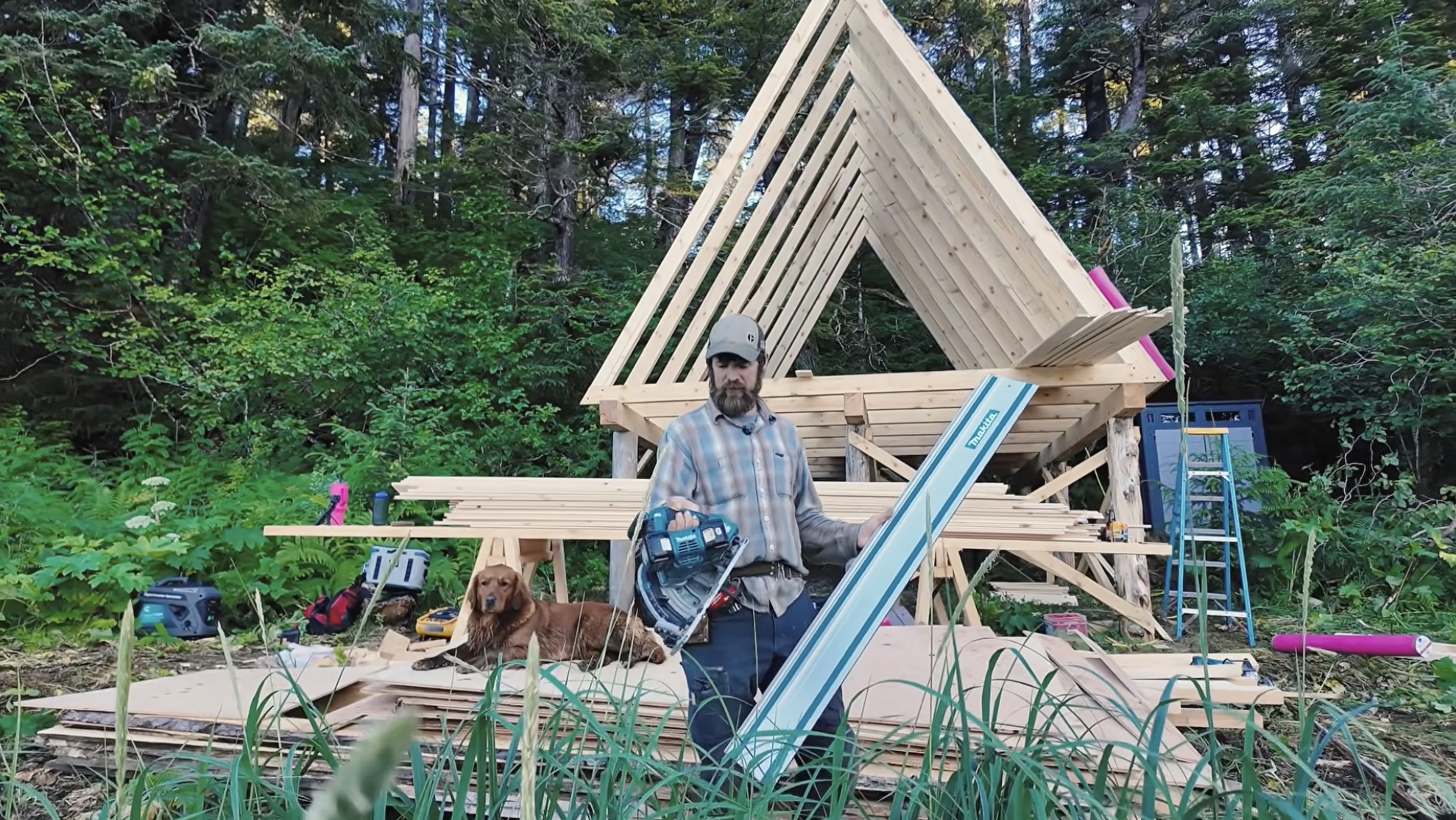
Working on remote properties in Southeast Alaska means thinking about more than how a tool performs once it’s plugged in. First, you have to get it to the job site. Then you need a way to power it.
For the off-grid cabin repairs and building projects we tackle through Alaskan Viking, a cordless track saw is one tool that earns its place. It gives us a portable way to make accurate cuts in plywood, flooring, and trim without hauling a table saw and generator ashore.
In this short video, I’m using a Makita cordless track saw to cut plywood on a remote building project.
Choosing tools for a remote job site
A tool that’s convenient in a driveway can be a different proposition when it needs to travel by skiff, ride ashore on a paddleboard, and get carried up a beach.
A job site table saw is wonderful to have on a framing project, especially when you’re cutting plywood sheathing. But its weight and bulk can make it difficult to justify on a remote build. Power is another consideration. Even with modern lightweight generators, having 110-volt power where you need it can be an unrealistic luxury.
Those logistics shape the tools we carry. How much can one tool accomplish? How awkward is it to load and unload? Can it run on batteries we’re already bringing?
Track saws have been around for a long time, but the cordless versions are what really caught my attention. A compact saw and a lightweight aluminum guide rail are a manageable load, and charged batteries let us work without setting up a generator for the saw.
Cutting plywood without a table saw
A track saw runs along a guide rail positioned on your material. Align the rail with your marks, and it guides the saw through a straight cut.
That’s especially useful when you’re handling full sheets of plywood alone. Feeding a large sheet through a table saw takes space and support on both sides. Without roller stands or a large worktable, keeping everything supported and aligned can be a challenge.
With a track saw, the plywood stays supported while the saw moves across it. On a remote cabin project, being able to cut sheet goods on a simple setup can save a lot of handling and effort.
Long tapers, flooring, and trim
Plywood is only part of the story. I also appreciate the track saw for ripping flooring and trim, particularly when a piece needs a long, gentle taper to fit.
Following that line smoothly with a handheld circular saw takes care. Setting up the same cut on a table saw can be awkward. With the track, I can align the guide with the cut I need and make a straight taper without building a separate jig.
Angled cuts across panels are similarly straightforward. That flexibility is useful in repair work, where the piece you need doesn’t always have parallel sides or square corners.
A simple support option for sheet goods
One setup I wasn’t using in this video is a flat panel of rigid foam insulation beneath the plywood. With the blade depth set just beyond the plywood’s thickness, the saw cuts slightly into the foam while it supports the material on both sides of the cut.
It’s a useful option when you don’t have a large cutting table, provided the panel sits on a stable surface and the cutting path is clear underneath.
A tool that earns the trip ashore
I don’t use my track saw daily. But when I do, I’m almost always impressed by how quickly it produces a clean, straight cut with relatively little setup.
It doesn’t replace every reason to own a table saw. For breaking down plywood and making long straight or tapered cuts at an off-grid job site, though, it offers a lot of capability in a portable package.
That’s part of remote property work: matching the tools and approach to the access, available power, and actual problem. At Alaskan Viking, those decisions are part of the job before the first load leaves the Alaskan Gypsy.
If you have a remote cabin repair or property project in Southeast Alaska, get in touch. Tell us where it is, what needs attention, and what access is available. Those details help us work out a practical approach.
– Scott
Leave a Reply